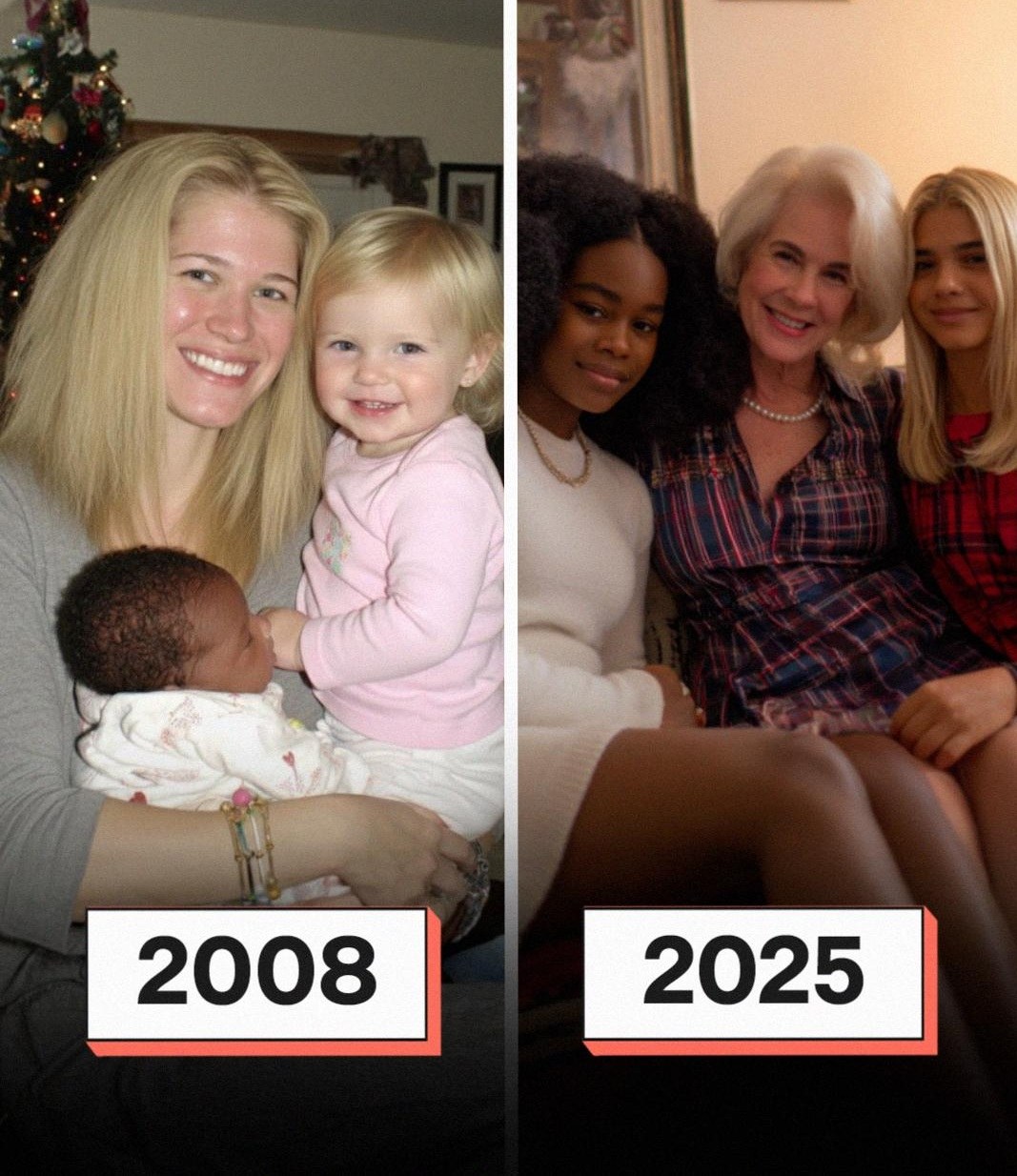
A desire not just to give life, but to nurture it, to hold someone who would call me “Mom,” to watch a child grow and shape the world alongside me.
Yet, as time passed, the dream was met with heartbreak. Miscarriage after miscarriage stole my hope, leaving a hollow ache in its place, a quiet grief that no one could see but that defined the rhythm of my days.
My husband, John, and I navigated this sorrow together, though each loss carved a different pattern in both our hearts.
We tried to speak carefully to one another, choosing words as cautiously as one might step across a creaking floorboard in an old house.
At night, we curled beside each other in our bed, holding hands without words, letting silence carry the weight of our grief.
I watched other women celebrate pregnancies, holding their ultrasound photos like treasures, and each time, a stab of emptiness struck me so sharp I sometimes feared it would never fade.
It was during one of those days, sitting in the parking lot of the fertility clinic, that I noticed a young woman stepping out, clutching her ultrasound image with a face aglow in joy.
My chest ached in a way I could not articulate; I had already shed all the tears my body could muster, and yet I felt a profound emptiness that left me silent, drained, and numb.
Months passed, and the cycle of hope and disappointment continued. “We can take a break,” John said one evening, his hands gently resting on my shoulders, thumbs tracing soft circles of reassurance.
“I don’t want a break. I want a baby,” I whispered back, my voice trembling. There was no argument, only understanding, because words were insufficient to capture the depth of longing, of desperation, of love waiting to pour into life.
The miscarriages came one after another, relentless in their cruelty. Each one felt faster, sharper, colder than the last, as though my body was betraying me in a silent, unrelenting way.
I remember folding tiny baby clothes for the third miscarriage, unable to resist the impulse to buy them on sale. I held a soft onesie with a little yellow duck on the front when the familiar, crushing warmth of loss enveloped me.
John’s patience was steadfast, but the toll was evident in both of us. He feared for me, for my heart, and for the invisible strain our shared grief was creating.
After the fifth miscarriage, our doctor’s words had changed. The gentle optimism of prior appointments had dissipated. “Some bodies just… don’t cooperate,” he said, his voice soft but final.
He suggested other avenues, including adoption, though neither of us was ready to abandon hope for our biological child.
One night, unable to sleep while John rested beside me, I crept quietly into the cold bathroom. I pressed my back to the bathtub, letting the chill seep into my skin, and stared at the grout lines between the tiles.
I counted the cracks, seeking some semblance of control, some distraction from the despair. It was the darkest point of my life—a place where hopelessness and longing collided.
Desperate, I prayed aloud for the first time in my life: “Dear God, please… if You give me a child, I promise I’ll save one too. If I become a mom, I will give a home to a child who has none.”
The words hung in the air, and for a long moment, nothing happened. I sobbed quietly, questioning whether anyone, anywhere, was listening.
Ten months later, my prayers were answered in the most miraculous way. Stephanie was born—screaming, pink, and furious at the world from the moment she entered it.
Her vitality and insistence on life were overwhelming, consuming. John and I held each other in tears, enveloping our new daughter in the love that had grown, unseen but immense, during the years of loss.
Every challenge, every heartbreak, suddenly felt like it had been a prelude to her arrival.
And yet, memory lingered quietly alongside joy. I had made a promise when I prayed, and that promise now needed fulfillment.
One year later, on Stephanie’s first birthday, I placed adoption papers in a gift-wrapped folder for John.
The act was simple but symbolic: a gesture that honored a vow made in a moment of despair, a promise to give love where it was needed most.
Two weeks later, we welcomed Ruth into our family. She had been abandoned on Christmas Eve, left near the city’s main Christmas tree.
Tiny, quiet, and entirely different from Stephanie, Ruth was a study in contrasts. While Stephanie commanded attention effortlessly, Ruth observed, measured, and learned.
She cried only when alone, disappearing into shadows of quiet self-preservation.
I had hoped their differences would complement one another, but as they grew, I realized just how stark those differences could be.
The love I felt for each was equal, but the experience of that love was not symmetrical. Stephanie was bold, unafraid, and natural in her self-expression.
Ruth was careful, introspective, and delicate in her approach to the world.
I loved them both fiercely, but parenting two such distinct spirits revealed an unexpected challenge: equality in intention did not always translate to equality in experience.
Subtle frictions emerged early and grew over time. The girls competed silently, their differences magnified by perception and circumstance.
Stephanie demanded attention effortlessly, Ruth quietly waited. At school, Stephanie’s confidence was praised; Ruth’s kindness often went unnoticed.
It felt as though our family had been cast in two complementary, yet opposing, dynamics.
As teenagers, the underlying tensions surfaced more aggressively. Arguments erupted over clothes, friends, attention—everyday conflicts that carried the weight of deeper, unspoken comparisons.
Yet nothing could have prepared me for the quiet heartbreak of the revelation Ruth shared one night.
Standing in her bedroom before prom, she said something that shattered the equilibrium I had worked so hard to maintain. “Mom, you’re not coming to my prom. After prom… I’m leaving.”
Confused, I asked, “Leaving? Why?”
Her voice trembled as she delivered the words I had not expected: “Stephanie told me the truth about you.”
In that moment, I felt time slow. The room chilled. My heart constricted. She went on: “That you prayed for Stephanie.
You promised that if God gave you a baby, you’d adopt a child. That’s why you got me. The only reason you got me.”
I sat on the edge of her bed, phone forgotten in my hand, and replied calmly, yet with the weight of honesty: “Yes. I did pray for a baby, and I did make that promise.
But, honey, you were never a transaction. I loved you from the moment I saw you. The vow did not create my love for you.
My love for Stephanie taught me I had more love to give, and the vow simply showed me where to direct it.”
She listened, processing, wrestling with the narrative she had built in her mind. Her anger and fear were not easily dispelled, yet the conversation opened a pathway toward healing, even if it would take time for her to walk it fully.
That night, she left for prom alone. I stayed awake, watching, worrying, hoping.
In the early hours of the morning, Stephanie came to me, exhausted and tear-streaked, confessing her role in the conflict.
She had overheard our private conversation and had repeated information, intending only to hurt Ruth during a fight.
Her apology was raw and sincere, a reminder that children, even with the best intentions, sometimes act out of misunderstanding or fear.
On the fourth day, Ruth returned, hesitating on the porch. She looked exhausted, vulnerable, yet still resolute. “I don’t want to be your promise,” she whispered. “I just want to be your daughter.”
I pulled her into my arms and held her close, feeling the tension dissolve in the warmth of reconnection.
“You always were, baby. You always were,” I whispered back, my heart breaking and mending in the same moment.
Tears flowed freely, uncontained, the kind that shake every fiber of your body. It was a moment of raw, unfiltered emotion—the culmination of years of love, loss, struggle, and growth.
From that day forward, our family began to rebuild itself, layer by careful layer. I learned that love is rarely tidy.
It is not a ledger of promises fulfilled or debts repaid. It is messy, challenging, and beautiful in its complexity.
My daughters taught me that love is resilient, capable of healing wounds that once seemed insurmountable.
The promise I made on that bathroom floor years ago was fulfilled not because it dictated action, but because it illuminated the path toward empathy, connection, and the enduring power of maternal love.
Stephanie and Ruth grew up knowing they were loved, each in her own way, each in her own story.
They taught me that family is more than biology or circumstance—it is commitment, patience, and the willingness to see the human heart beneath the surface.
And in that realization, I found a truth more profound than any dream I had nurtured in the years of waiting: the heart’s capacity for love is infinite.
It grows with every loss endured, every hand held, every tear wiped away.
It is expansive enough to cradle both the child I bore and the child I chose, to embrace joy and heartbreak alike, and to allow me to remain whole even when life threatened to break me.