Spending time outdoors has always felt like a source of peace for Kym Beechey, an Australian woman who finds comfort and joy in nature’s quiet beauty. She often explores local forests, taking in the gentle breeze, the colorful landscapes, and the calming rhythm of the trees. Photography is her way of capturing those small wonders—flowers she’s never seen before, playful wildlife, and the unexpected moments that make each walk unforgettable. On one of her recent outings, the forest was especially serene, the kind of afternoon that invites you to slow down and notice every detail around you.
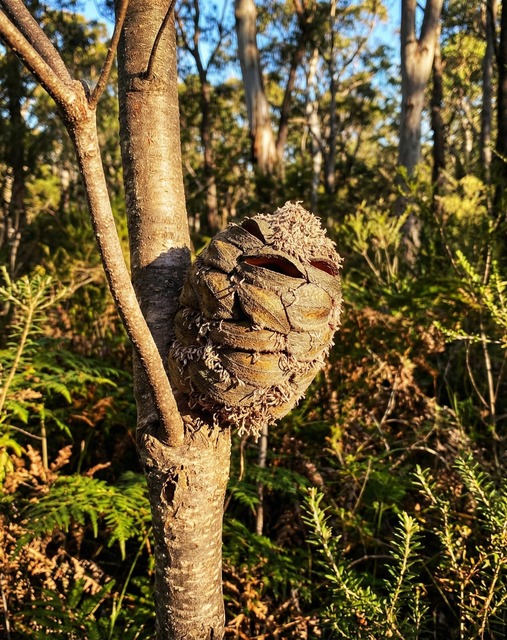
As Kym followed a narrow path bordered by tall trees and dappled sunlight, something perched on a fallen branch caught her attention. At first glance, it looked like a baby tawny frogmouth—a small Australian bird known for its owl-like appearance and soft, feathery features. Its round shape and seemingly gentle expression made her smile instantly. Excited by the idea of capturing such a rare moment, she quickly reached for her phone. She imagined taking the perfect close-up photo of a tiny forest visitor, a picture she could later share with friends who appreciated wildlife just as much as she did.
When she finally zoomed in on the little figure, Kym paused. The “baby bird” wasn’t moving, and something about its texture seemed unusual. After adjusting the focus, she suddenly recognized what she was actually looking at—a banksia pod. These pods, produced by the native banksia tree, are known for their unique shapes and eye-like patterns that can resemble animal faces from a distance. Found mostly in southwestern Australia but also in parts of New Zealand and Papua New Guinea, banksia pods open naturally during heat, often after forest fires, releasing their seeds into the surrounding landscape. Their appearance can be both fascinating and misleading, which explained why Kym’s initial impression had been so convincing.
Once she understood her mistake, Kym couldn’t help but laugh. What she thought was a sweet bird resting quietly had turned out to be one of nature’s quirky illusions. Rather than feeling embarrassed, she appreciated the moment even more—it was another reminder of how surprising and playful the natural world can be. She decided to share the photo online, inviting others to enjoy the optical illusion and see whether they, too, would have mistaken the pod for a tiny bird. Many people admitted they would have fallen for the same trick, and the lighthearted moment brought smiles to others as well. In the end, Kym’s forest walk became more memorable than she expected, proving once again that nature always has a way of surprising us when we take the time to look closely.